Piton de la Fournaise · La Réunion · Sentinel-1
An eruption between two radar passes.
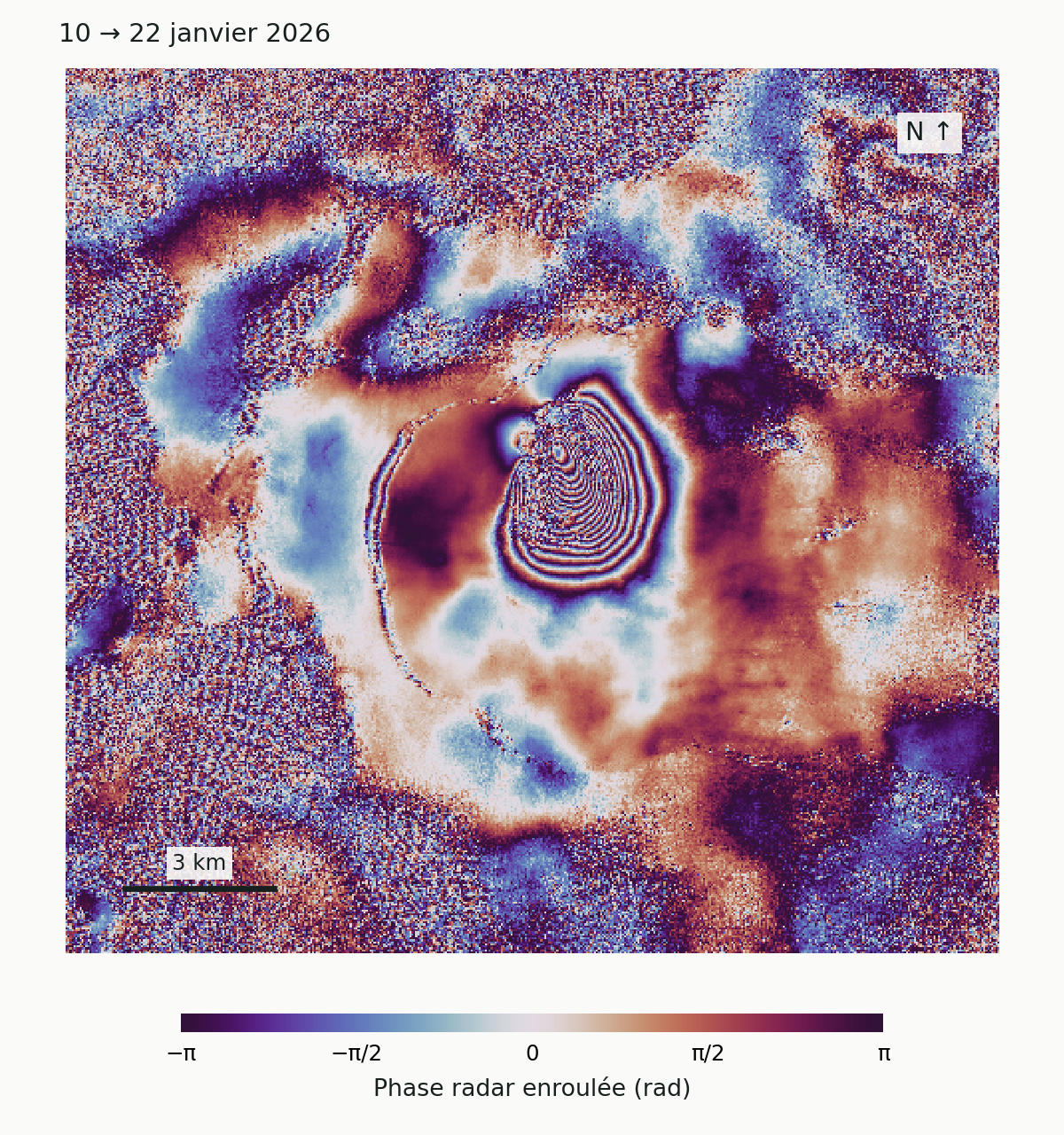
Two satellite passes, on 10 and 22 January 2026, bracket the eruption that began on 18 January and ended on 20 January, according to the bulletin of the Piton de la Fournaise Volcano Observatory (OVPF-IPGP, in French); see also SERTIT’s mapping. This pair cannot isolate movement before the eruption. Around the summit, radar fringes reveal phase variations that InSAR can analyse to study ground displacement.
Read the fringes.
Colour follows radar phase and returns to its starting point after a full cycle. For the 5.55 cm wavelength used in this processing, one cycle corresponds to approximately 2.8 cm of range change along the satellite’s line of sight.
From phase to displacement.
The map shows wrapped phase computed directly from the complex interferogram. Rendering adds no smoothing or interpolation. Fringes alone do not provide an uplift height: atmospheric effects and noise also contribute to the signal. Phase unwrapping, coherence checks and a reference choice are needed to derive a line-of-sight displacement field.
This view uses the study’s initial product, without atmospheric correction or an additional phase reference. It retains the full raster extent and uses a cyclic colour scale. Low-coherence areas remain visible; they are not presented as reliable displacement measurements.
The eruption and the figure, in brief
According to the Piton de la Fournaise Volcano Observatory (OVPF-IPGP), the eruption began on 18 January 2026 at 15:45 UTC (19:45 local time) on the northern flank, inside the Enclos Fouqué caldera, and stopped on 20 January at about 01:00 UTC, after about 33 hours. 4 fissures opened and about 0.88 million m³ of lava were erupted. The observatory reports rapid displacements of up to 60 cm on the northern flank of the summit cone, measured by GNSS and confirmed by InSAR.
The two radar images bracket the eruption: the first 8 days before it began, the second 2 days after it ended. The figure covers 18.8 × 17.8 km with 40 m pixels. One full colour cycle corresponds to about 2.8 cm of range change along the line of sight: as an order of magnitude, 60 cm of range change would amount to some twenty cycles (22), where coherence allows them to be followed.
Data sheet: sources, processing, limits, citation
- What the figure shows
- Wrapped interferometric phase (from −π to π radians) between two Sentinel-1 acquisitions, on 10 and 22 January 2026. Each coloured fringe corresponds to the same change in distance between the ground and the satellite.
- Source data
- Sentinel-1 radar images of 10 and 22 January 2026 — Copernicus programme (European Union, ESA); 5.55 cm wavelength (C band).
- Eruption chronology — OVPF-IPGP, monthly bulletin for January 2026, published on 4 February 2026 (ISSN 2610-5101). (source)
- fiñv processing
- Multilooked, filtered interferogram from fiñv’s interferometric processing. The figure shows the angle of the complex interferogram; zero-amplitude pixels are masked; cyclic palette; nearest-neighbour rendering, with no additional smoothing or interpolation; full extent retained.
- Grid
- EPSG:32740 (UTM zone 40 South), 40 m pixels, 470 × 446 pixels.
- Convention
- One colour cycle (2π) = half a wavelength, about 2.8 cm of range change along the line of sight.
- Limits
- Initial product, with no atmospheric correction or phase reference. Wrapped phase is neither a displacement in centimetres nor a vertical deformation map; no source or magnitude is inferred from it here. The line of sight is not vertical. The pair does not separate pre-eruptive from eruptive motion. Eruption figures are OVPF’s, not measurements derived from this figure.
- Version and integrity
- SHA-256 fingerprint of the published figure: 4ad8f20f6266… (matches the provenance record)
- Cite and reuse
-
Le Corvec, N. (2026). Piton de la Fournaise: Sentinel-1 interferogram, 10–22 January 2026 [figure]. fiñv. https://finv.earth/en/work/piton-fournaise/
Figure under CC BY 4.0. Contains modified Copernicus Sentinel data (2026). Eruption chronology: OVPF-IPGP.